
Crafting Convenience: A Journey into Redefining the Laundry Experience
Hey everyone! Feeling like your laundry routine is a never-ending cycle of chaos and confusion? what if I tell you that this loop has a solution for the tiring task? Yes! My main aim is to redefine the laundry basket that make the user feel the ease of the object. Glad to introduce the Redefined Laundry Basket Get ready to dump the tiring Laundry Basket and hello to a laundry experience that’s as smooth as a cakewalk.
This project aims to cherish the user’s valuable time makes sense and reduces the workload as well. We all know there is no escapism in our real-world activities, but as we are smarter enough, we can make it as efficient as possible. Let’s dive in and see how I made your work easy peasy!!!
Introducing Redesigned Laundry Basket: Enhancing Everyday Tasks
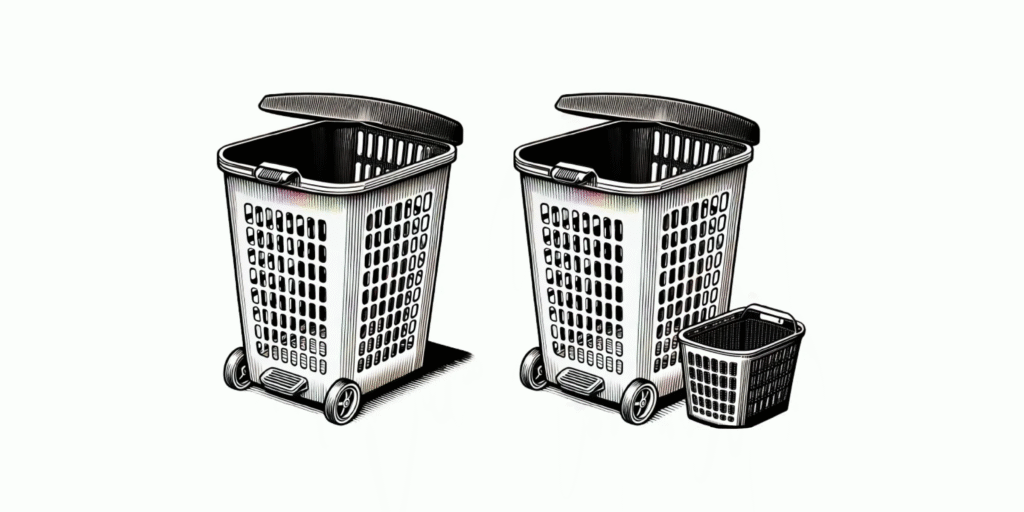
I’m thrilled to describe my idea of the final prototype of the redesigned laundry basket. As you can see the picture below clearly explains the proposed idea. I’ve come up with several customizations that make the users’ needs easy. The redesigned basket features a customized design for easy storage that can hold more used clothes than usual and has customizable compartments for various loads that vary in sizes.
How does the proposed Laundry Basket work with ease?
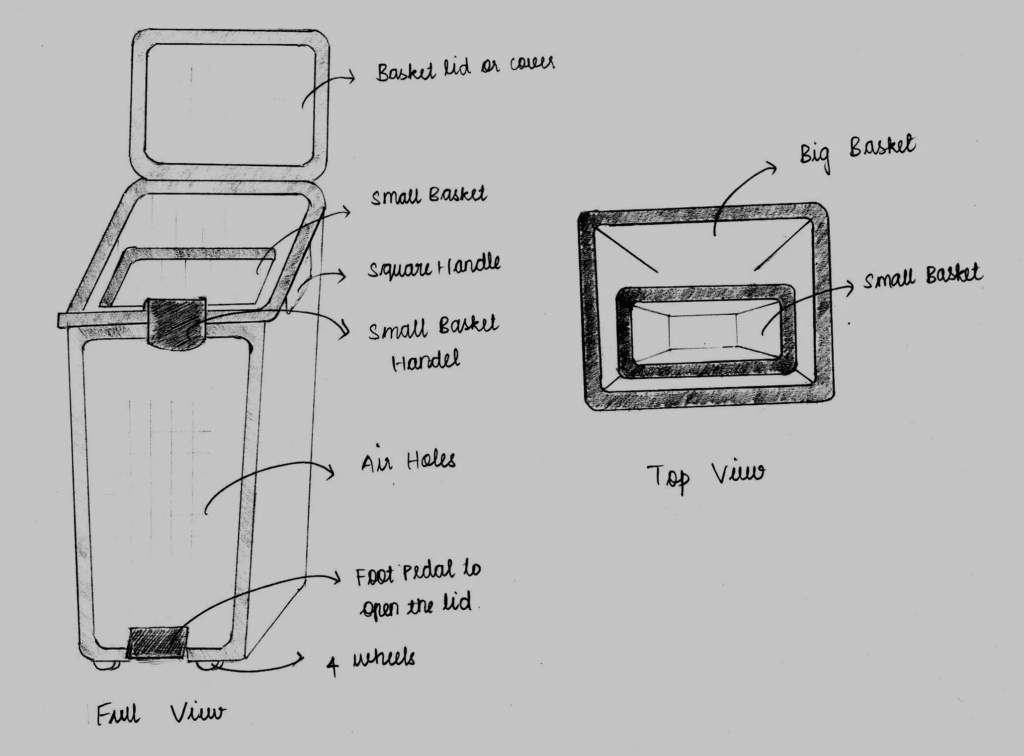
So, the redefined laundry basket consists of two segments namely the main basket and the small detachable basket. Users can detach the small basket when needed and keep it customized as per their needs. To make it more easily transportable the user can keep it movable as I have designed four wheels where there is no need to carry the heavy laundry basket but still, there are also square-shaped handles on both sides that can be used when the user needs lifting and carrying.
To add on there is a foot pedal segment that can open the lid of the basket that doesn’t make the user bending or lifting to open the lid of the basket. There are also air ventilation holes throughout the basket that don’t make the used clothes smell worse and do not build the moisture content more. Overall, the design aims to look at the laundry sorting and transportation process, making it more efficient and user-friendly.
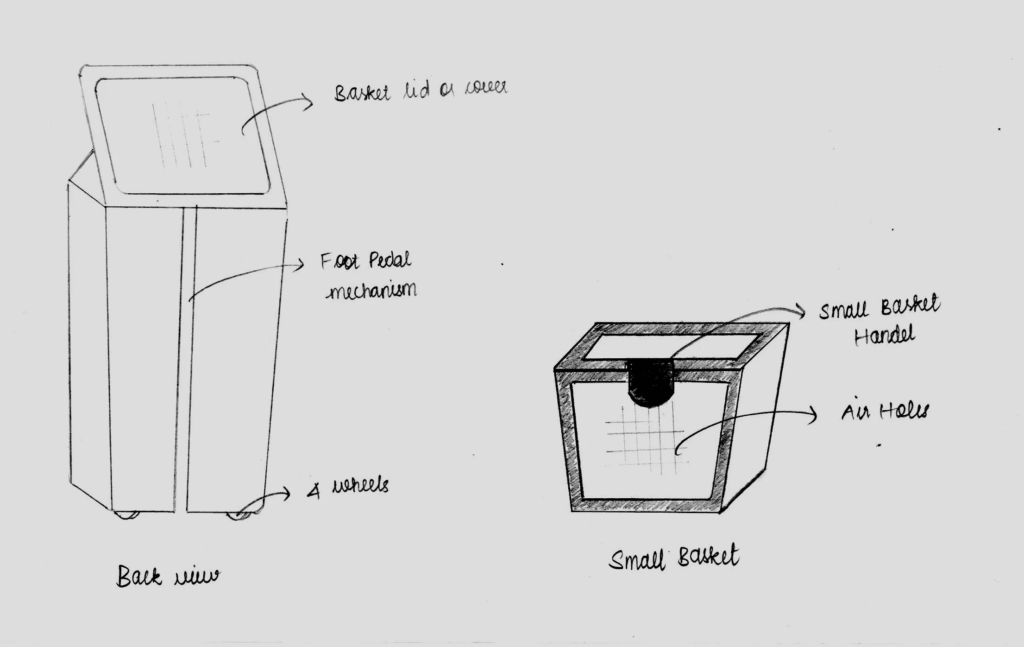
To be more specific and for easy understanding to the user the key features are enlightened below:
Let’s Explore the Real-world Functionality of the Redesigned Laundry Basket:
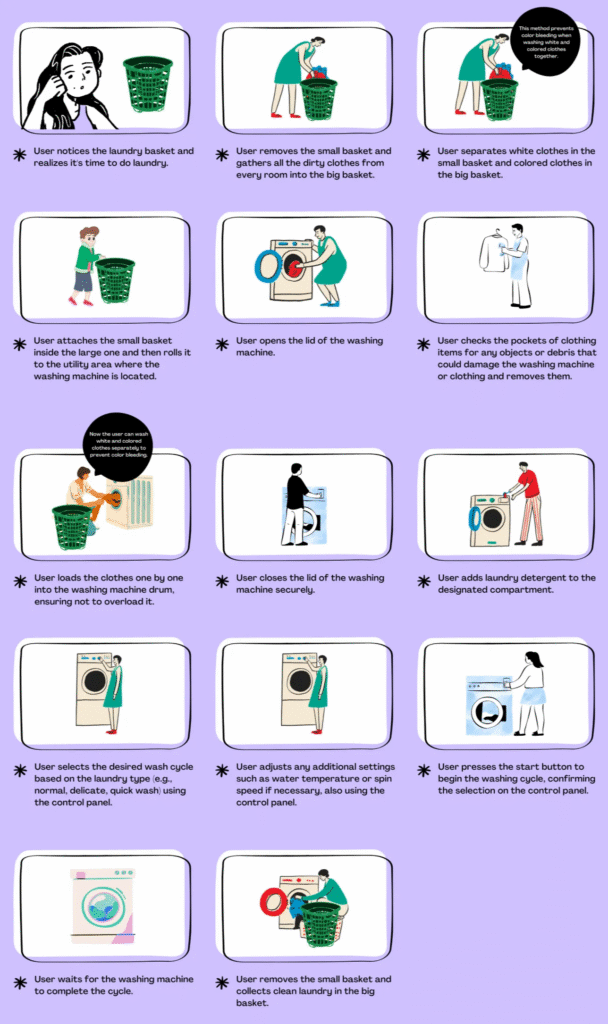
Come let’s picturize a scenario to get to see a realistic flow. It was already a hectic day and then the user realized it was time to do laundry, but wondered how the work was done right without stress because of the burdenless laundry basket. The user patiently collects all the clothes in the basket from different rooms and separates them based on the types that have to be washed accordingly such as whites and colors in the small and large basket and again the user throws the small basket into the large one, to roll it to the utility area. Then the user loaded these clothes into the machine one by one. The user waits for the familiar hum of the machine as it works its magic. Wow!! The outcome was a success, and the user collected the clean laundry in the small basket.
Understanding Laundry Problems: Leading to a Redesigned Basket
We’ll talk about the main problems people face when doing laundry. Look at things like how hard it is to sort clothes, carry heavy loads, and store laundry baskets. By figuring out these basic issues, I can find ways to make laundry easier and more practical for everyone. So, let’s get started and see what problems our new laundry basket is trying to solve!
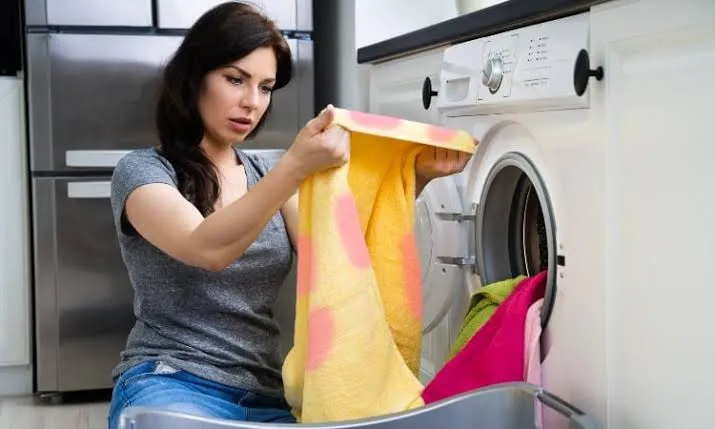
Tackling laundry challenges like sorting, carrying heavy loads, basket ventilation, space constraints, and accessibility is crucial for making laundry easier. By understanding these basic problems, I can create solutions that make laundry tasks simpler and more convenient for everyone. With thoughtful design and attention to user needs, I can develop solutions that truly improve the laundry experience for all.
Following the Laundry Troubles: How Problems Led to Solutions
We all can see that several problems are faced by the user, the ideology is to explore how I identified and addressed the main issues in the utility area. By focusing on this area, I aimed to focus on solving issues faced by the user and also enhance the overall laundry experience for users. The utility area, often overlooked in homes, plays a vital role in the laundry process, serving as a central hub for washing clothes. By selecting this area, I can solve some common challenges faced by users.
I began by crafting a set of interview questions to get to know about the user behaviors and pain points. However, the initial interviews provided limited insights, prompting me to re-evaluate my approach. I then conducted further research, focusing specifically on the utility area, and identified 10 user goals related to this space. From these goals, I selected the top 3 and developed user journeys to better understand the user experience. With these insights, I revised my interview questions and conducted three more interviews, ensuring that I captured a comprehensive understanding of user needs and pain points in the context of the utility area.
As the interviews progressed, I got to see the issues leading to a deeper understanding of user needs and frustrations. Upon completing the interviews, I documented all the insights gathered and identified the user goal of “Washing clothes using the washing machine” for further project development. This user goal was chosen based on its significance in the laundry process during the interviews.
Insights of the specific Information that was gathered for research:
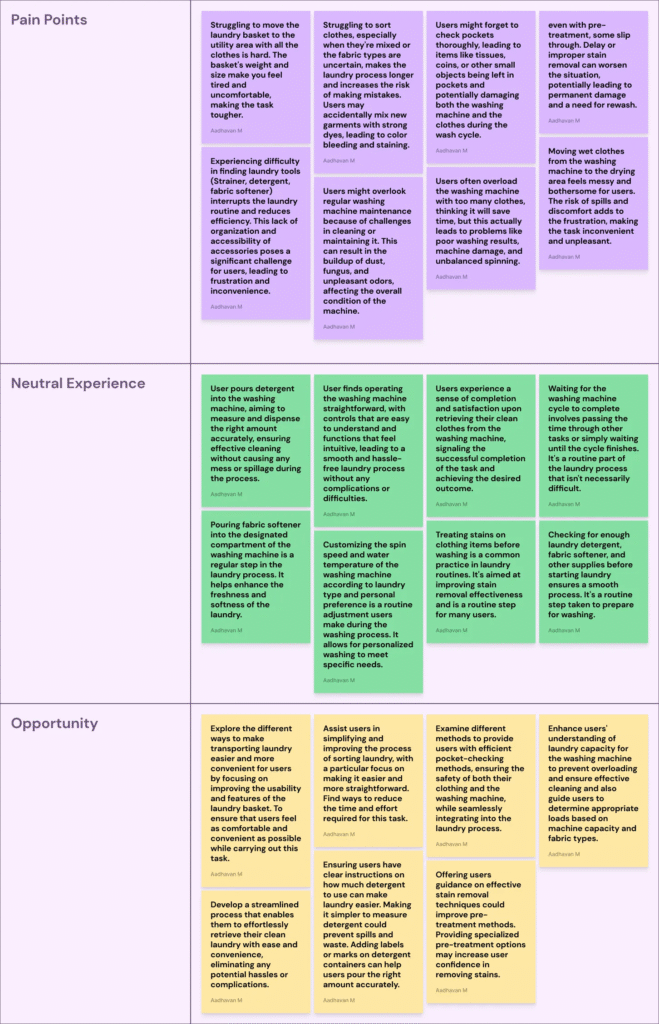
Through interviews and analyzing user goals, I noted down all the actions and decisions to tackle laundry challenges. In addition to this, I have also noted down the pain points, neutral experiences, and opportunities from interviews. This detailed process is integral to my project, as it helps me understand where users struggle, what works well for them, and areas where improvements can be made. You can find all the data below.
Mapping the User Journey from Insights and Opportunities:
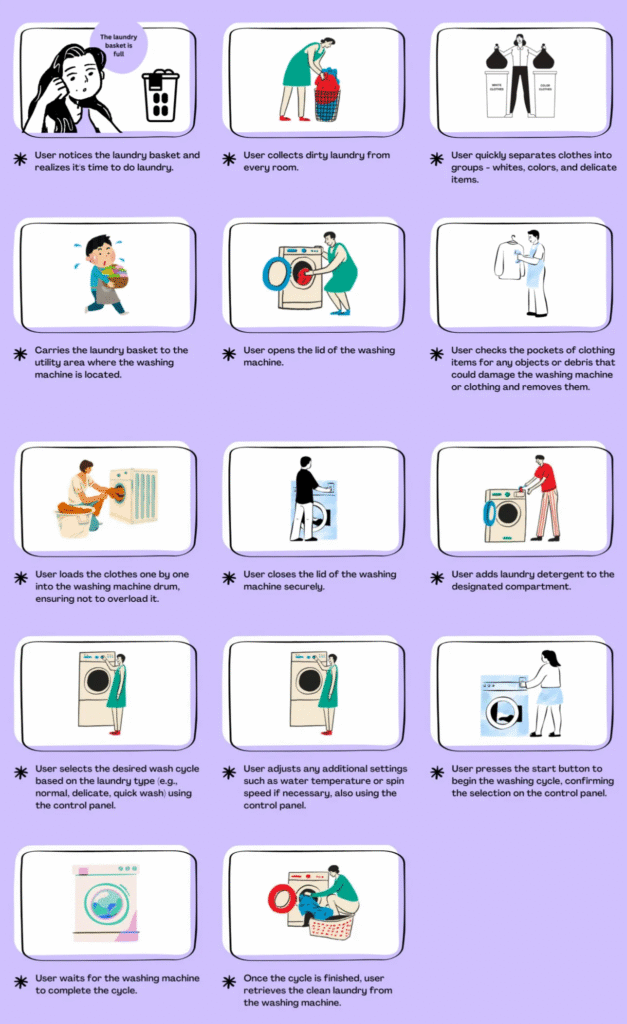
Let’s see how the idea is being mapped from the beginning. The user begins by noticing the laundry basket, signaling it’s time to tackle the task. They efficiently gather dirty laundry from various rooms, and then head to the laundry room for sorting. After dividing clothes into whites, colors, and delicates, they open the washing machine and check pockets for debris. Clothes are carefully loaded into the machine drum, detergent is added, and the wash cycle is selected. With a press of the start button, the cycle begins, and the user patiently waits for completion. Once finished, they retrieve clean laundry from the machine.
Defined Data to Proposed Ideas:
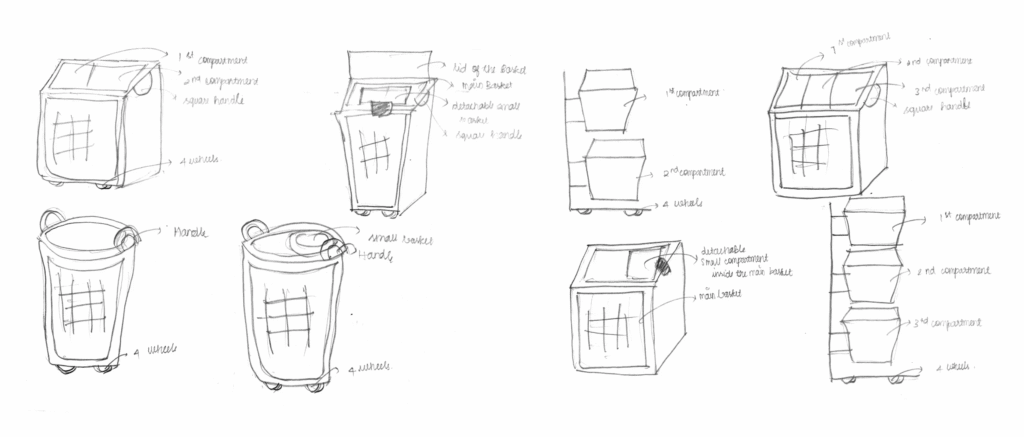
Based on the insights and the user journey that I have seen previously, I engaged in creative brainstorming sessions, known as crazy 8, where I generated eight unique ideas aimed at addressing the identified pain points and neutral experiences in the laundry process. Designed various prototypes of laundry baskets, each with distinct features and functionalities. From these initial concepts, I carefully selected three ideas; to further refine and validate these concepts, I conducted thorough research. This iterative process allowed me to narrow down my focus on developing effective solutions to enhance the overall laundry journey.
Here are my creative Ideas for prototypes that were planned systematically:
I carefully crafted the design of the laundry basket prototype, incorporating various features that address common pain points. Inspired by user insights and extensive research, the prototype has multiple functionalities, including a removable small basket, four sturdy wheels, and ventilation holes. Additionally, a square-shaped handle was integrated on both sides of the basket to facilitate easy lifting. This comprehensive design aimed to revolutionize the laundry experience, offering users a user-friendly solution to their everyday challenges.
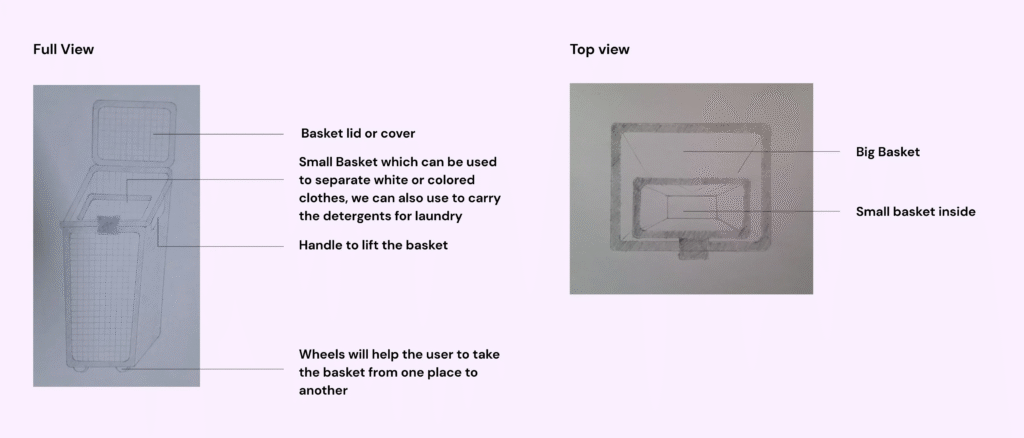
Following the prototype presentation to peers, valuable feedback was gathered, highlighting concerns regarding limited storage space and user discomfort during the laundry process. Responding to these insights, I conducted further research and came up with the foot pedal feature which offers users a hands-free mechanism to open the basket lid effortlessly. With this feature, the final product emerged as a refined solution. It’s important to note that the final prototype you’ve seen previously represents the culmination of this iterative process.
Key Choices Along the Way: Navigating Project Decisions
As we have seen the whole project journey of this project, now let’s see what the critical decisions I made during the project. These thought processes were super important and helped a lot in making the final solution. By talking about these key choices, I can understand better how the project went and how I solved problems. This section helps to see how I made decisions and solved issues to reach our goals.

Advancing the Laundry Basket: Future Product Enhancements
I explored potential places for improving the design and functionality of the laundry basket prototype. Despite the progress made, there are still opportunities to refine and expand upon the initial concept.
The future scope of the project defines a range of enhancements aimed at elevating the usability of the laundry basket prototype. By incorporating these improvements, I can continue to refine the design and deliver a product that meets the evolving needs of users.
Project Learnings: Designing the Perfect Laundry Basket
Reflecting on the journey of designing the perfect laundry basket, several key learnings emerged, shaping not only the project but also my approach to future endeavors.

The Mistake I made: Initially, I assumed I understood user needs based on my assumptions and experiences rather than conducting thorough user research.
Learnings: I learned the significance of empathizing with users to understand their needs, using interviews and observations. Prioritizing user feedback and insights ensured that the solutions addressed specific pain points and provided meaningful value. Continuous validation through user testing allowed for early correction, resulting in more successful outcomes.
The Mistake I made: I initially explored numerous ideas without considering feasibility and user needs.
Learnings: I learned to evaluate ideas based on feasibility and alignment with user needs. By asking questions like “How feasible is this idea?” and “Does it solve a real user problem?” I was able to narrow down to practical solution ideas that formed the basis for developing the prototype.
The Mistake I made: Initially, I received feedback about usability issues, especially for users with back pain, which I hadn’t considered.
Learnings: I learned the importance of continuous refinement and addressing specific user feedback. Adding a foot pedal for hands-free lid opening made the design more user-friendly and accessible for individuals with mobility issues.
The journey of designing the perfect laundry basket was not just about creating a product; it was a transformative learning experience. These learnings have equipped me with valuable skills and insights that will undoubtedly shape my future projects and endeavors in design and problem-solving.
Seeking Your Valuable Feedback to Elevate My Project!
I’m thrilled to share my project with you and would greatly appreciate your feedback to help me refine and enhance it further. Your insights are invaluable to me, and I’m eager to hear your thoughts on the following aspects of my project.

Thank you so much for your time and thoughts! If you liked the project or have suggestions, connect with me via DM on social media ❤ — LinkedIn
Crafting Convenience: A Journey into Redefining the Laundry Experience
Hey everyone! Feeling like your laundry routine is a never-ending cycle of chaos and confusion? what if I tell you that this loop has a solution for the tiring task? Yes! My main aim is to redefine the laundry basket that make the user feel the ease of the object. Glad to introduce the Redefined Laundry Basket Get ready to dump the tiring Laundry Basket and hello to a laundry experience that’s as smooth as a cakewalk.
This project aims to cherish the user’s valuable time makes sense and reduces the workload as well. We all know there is no escapism in our real-world activities, but as we are smarter enough, we can make it as efficient as possible. Let’s dive in and see how I made your work easy peasy!!!
Introducing Redesigned Laundry Basket: Enhancing Everyday Tasks
I’m thrilled to describe my idea of the final prototype of the redesigned laundry basket. As you can see the picture below clearly explains the proposed idea. I’ve come up with several customizations that make the users’ needs easy. The redesigned basket features a customized design for easy storage that can hold more used clothes than usual and has customizable compartments for various loads that vary in sizes.
How does the proposed Laundry Basket work with ease?
So, the redefined laundry basket consists of two segments namely the main basket and the small detachable basket. Users can detach the small basket when needed and keep it customized as per their needs. To make it more easily transportable the user can keep it movable as I have designed four wheels where there is no need to carry the heavy laundry basket but still, there are also square-shaped handles on both sides that can be used when the user needs lifting and carrying.
To add on there is a foot pedal segment that can open the lid of the basket that doesn’t make the user bending or lifting to open the lid of the basket. There are also air ventilation holes throughout the basket that don’t make the used clothes smell worse and do not build the moisture content more. Overall, the design aims to look at the laundry sorting and transportation process, making it more efficient and user-friendly.
To be more specific and for easy understanding to the user the key features are enlightened below:
Let’s Explore the Real-world Functionality of the Redesigned Laundry Basket:
Come let’s picturize a scenario to get to see a realistic flow. It was already a hectic day and then the user realized it was time to do laundry, but wondered how the work was done right without stress because of the burdenless laundry basket. The user patiently collects all the clothes in the basket from different rooms and separates them based on the types that have to be washed accordingly such as whites and colors in the small and large basket and again the user throws the small basket into the large one, to roll it to the utility area. Then the user loaded these clothes into the machine one by one. The user waits for the familiar hum of the machine as it works its magic. Wow!! The outcome was a success, and the user collected the clean laundry in the small basket.
Understanding Laundry Problems: Leading to a Redesigned Basket
We’ll talk about the main problems people face when doing laundry. Look at things like how hard it is to sort clothes, carry heavy loads, and store laundry baskets. By figuring out these basic issues, I can find ways to make laundry easier and more practical for everyone. So, let’s get started and see what problems our new laundry basket is trying to solve!
Tackling laundry challenges like sorting, carrying heavy loads, basket ventilation, space constraints, and accessibility is crucial for making laundry easier. By understanding these basic problems, I can create solutions that make laundry tasks simpler and more convenient for everyone. With thoughtful design and attention to user needs, I can develop solutions that truly improve the laundry experience for all.
Following the Laundry Troubles: How Problems Led to Solutions
We all can see that several problems are faced by the user, the ideology is to explore how I identified and addressed the main issues in the utility area. By focusing on this area, I aimed to focus on solving issues faced by the user and also enhance the overall laundry experience for users. The utility area, often overlooked in homes, plays a vital role in the laundry process, serving as a central hub for washing clothes. By selecting this area, I can solve some common challenges faced by users.
I began by crafting a set of interview questions to get to know about the user behaviors and pain points. However, the initial interviews provided limited insights, prompting me to re-evaluate my approach. I then conducted further research, focusing specifically on the utility area, and identified 10 user goals related to this space. From these goals, I selected the top 3 and developed user journeys to better understand the user experience. With these insights, I revised my interview questions and conducted three more interviews, ensuring that I captured a comprehensive understanding of user needs and pain points in the context of the utility area.
As the interviews progressed, I got to see the issues leading to a deeper understanding of user needs and frustrations. Upon completing the interviews, I documented all the insights gathered and identified the user goal of “Washing clothes using the washing machine” for further project development. This user goal was chosen based on its significance in the laundry process during the interviews.
Insights of the specific Information that was gathered for research:
Through interviews and analyzing user goals, I noted down all the actions and decisions to tackle laundry challenges. In addition to this, I have also noted down the pain points, neutral experiences, and opportunities from interviews. This detailed process is integral to my project, as it helps me understand where users struggle, what works well for them, and areas where improvements can be made. You can find all the data below.
Mapping the User Journey from Insights and Opportunities:
Let’s see how the idea is being mapped from the beginning. The user begins by noticing the laundry basket, signaling it’s time to tackle the task. They efficiently gather dirty laundry from various rooms, and then head to the laundry room for sorting. After dividing clothes into whites, colors, and delicates, they open the washing machine and check pockets for debris. Clothes are carefully loaded into the machine drum, detergent is added, and the wash cycle is selected. With a press of the start button, the cycle begins, and the user patiently waits for completion. Once finished, they retrieve clean laundry from the machine.
Defined Data to Proposed Ideas:
Based on the insights and the user journey that I have seen previously, I engaged in creative brainstorming sessions, known as crazy 8, where I generated eight unique ideas aimed at addressing the identified pain points and neutral experiences in the laundry process. Designed various prototypes of laundry baskets, each with distinct features and functionalities. From these initial concepts, I carefully selected three ideas; to further refine and validate these concepts, I conducted thorough research. This iterative process allowed me to narrow down my focus on developing effective solutions to enhance the overall laundry journey.
Here are my creative Ideas for prototypes that were planned systematically:
I carefully crafted the design of the laundry basket prototype, incorporating various features that address common pain points. Inspired by user insights and extensive research, the prototype has multiple functionalities, including a removable small basket, four sturdy wheels, and ventilation holes. Additionally, a square-shaped handle was integrated on both sides of the basket to facilitate easy lifting. This comprehensive design aimed to revolutionize the laundry experience, offering users a user-friendly solution to their everyday challenges.
Key Choices Along the Way: Navigating Project Decisions
As we have seen the whole project journey of this project, now let’s see what the critical decisions I made during the project. These thought processes were super important and helped a lot in making the final solution. By talking about these key choices, I can understand better how the project went and how I solved problems. This section helps to see how I made decisions and solved issues to reach our goals.
Advancing the Laundry Basket: Future Product Enhancements
I explored potential places for improving the design and functionality of the laundry basket prototype. Despite the progress made, there are still opportunities to refine and expand upon the initial concept.
The future scope of the project defines a range of enhancements aimed at elevating the usability of the laundry basket prototype. By incorporating these improvements, I can continue to refine the design and deliver a product that meets the evolving needs of users.
Project Learnings: Designing the Perfect Laundry Basket
Reflecting on the journey of designing the perfect laundry basket, several key learnings emerged, shaping not only the project but also my approach to future endeavors.
The Mistake I made: Initially, I assumed I understood user needs based on my assumptions and experiences rather than conducting thorough user research.
Learnings: I learned the significance of empathizing with users to understand their needs, using interviews and observations. Prioritizing user feedback and insights ensured that the solutions addressed specific pain points and provided meaningful value. Continuous validation through user testing allowed for early correction, resulting in more successful outcomes.
The Mistake I made: I initially explored numerous ideas without considering feasibility and user needs.
Learnings: I learned to evaluate ideas based on feasibility and alignment with user needs. By asking questions like “How feasible is this idea?” and “Does it solve a real user problem?” I was able to narrow down to practical solution ideas that formed the basis for developing the prototype.
The Mistake I made: Initially, I received feedback about usability issues, especially for users with back pain, which I hadn’t considered.
Learnings: I learned the importance of continuous refinement and addressing specific user feedback. Adding a foot pedal for hands-free lid opening made the design more user-friendly and accessible for individuals with mobility issues.
The journey of designing the perfect laundry basket was not just about creating a product; it was a transformative learning experience. These learnings have equipped me with valuable skills and insights that will undoubtedly shape my future projects and endeavors in design and problem-solving.
Seeking Your Valuable Feedback to Elevate My Project!
I’m thrilled to share my project with you and would greatly appreciate your feedback to help me refine and enhance it further. Your insights are invaluable to me, and I’m eager to hear your thoughts on the following aspects of my project.
Thank you so much for your time and thoughts! If you liked the project or have suggestions, connect with me via DM on social media ❤ — LinkedIn