
User Journey Mapping
Mapped the end-to-end journey of users managing their laundry in shared spaces – uncovered pain points in physical handling, sorting, and hygiene, leading to a more thoughtful redesign.
For the Laundry Basket Redesign project, I conducted contextual research and mapped the user journey of individuals living in PGs and small apartments. These users regularly dealt with a mix of laundry from multiple housemates, making sorting and transport inconvenient.
What I did:
– Difficulty in separating clothes by type (e.g., whites, delicates, regular wash).
– Physical strain from carrying overloaded baskets.
– Bad odor due to poor airflow in closed plastic baskets.
– Space taken up by bulky baskets when not in use.
– Sorting (Confusion, delay).
– Transport (Physical discomfort).
– Post-laundry (No ventilation, clutter).
– Detachable baskets for easy pre-sorting.
– Wheels for effortless mobility.
– Ventilation holes to reduce odor buildup.
– Foldable structure for space-saving when not in use.
This journey map helped move beyond surface-level assumptions and design with empathy for everyday tasks that are often overlooked but physically and mentally taxing.
Case Study: Redesigned Laundry Basket Project
Visual Reference:
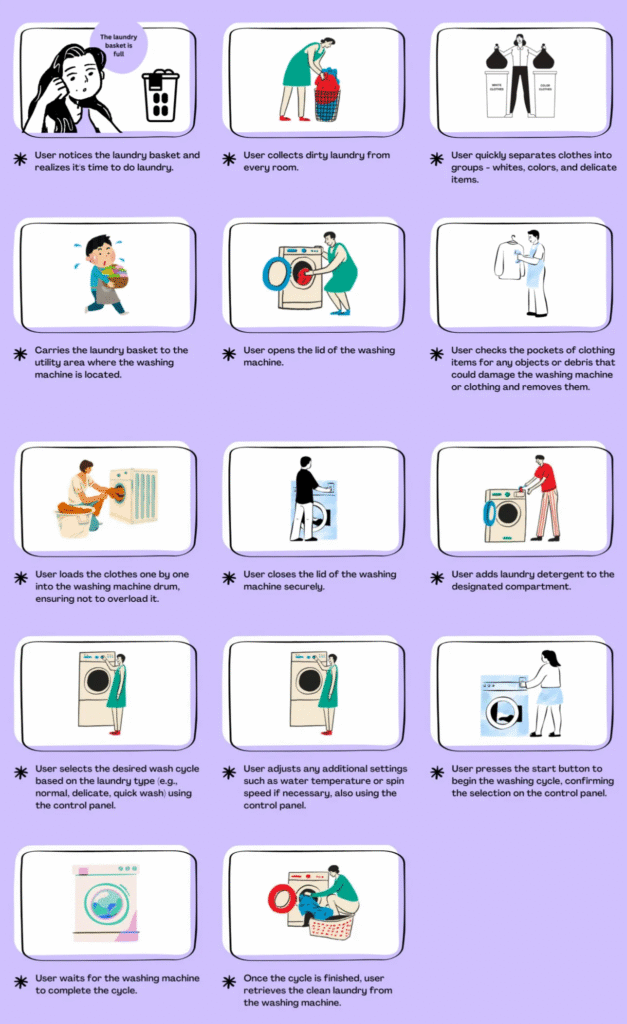
User Journey Mapping
Mapped the end-to-end journey of users managing their laundry in shared spaces – uncovered pain points in physical handling, sorting, and hygiene, leading to a more thoughtful redesign.
For the Laundry Basket Redesign project, I conducted contextual research and mapped the user journey of individuals living in PGs and small apartments. These users regularly dealt with a mix of laundry from multiple housemates, making sorting and transport inconvenient.
What I did:
– Difficulty in separating clothes by type (e.g., whites, delicates, regular wash).
– Physical strain from carrying overloaded baskets.
– Bad odor due to poor airflow in closed plastic baskets.
– Space taken up by bulky baskets when not in use.
– Sorting (Confusion, delay).
– Transport (Physical discomfort).
– Post-laundry (No ventilation, clutter).
– Detachable baskets for easy pre-sorting.
– Wheels for effortless mobility.
– Ventilation holes to reduce odor buildup.
– Foldable structure for space-saving when not in use.
This journey map helped move beyond surface-level assumptions and design with empathy for everyday tasks that are often overlooked but physically and mentally taxing.
Case Study: Redesigned Laundry Basket Project
Visual Reference: